Sleeping with the Enemy: The House Where Nothing Was Allowed to Be Wrong
In 1991, Julia Roberts arrived in theaters off Pretty Woman and an Oscar nomination for Steel Magnolias. She was America's girlfriend, the smile everyone had come to see. Sleeping with the Enemy took her to the opposite place: a glass house full of silence, where she doesn't smile, because smiling at the wrong moment could cost her. Joseph Ruben's film, adapted from Nancy Price's 1987 novel, crossed $100 million at the domestic box office — $101.6 million, on a $19 million budget. What makes it unforgettable, though, is the sensation it leaves behind: two hours spent breathing the air of a house where no one is permitted to make a mistake.
It begins with towels
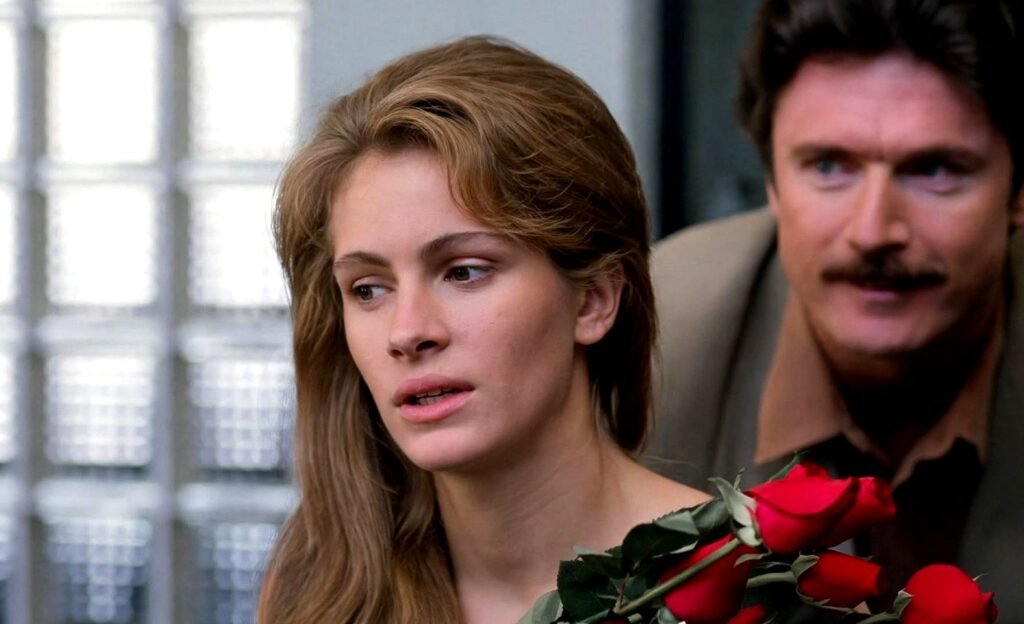
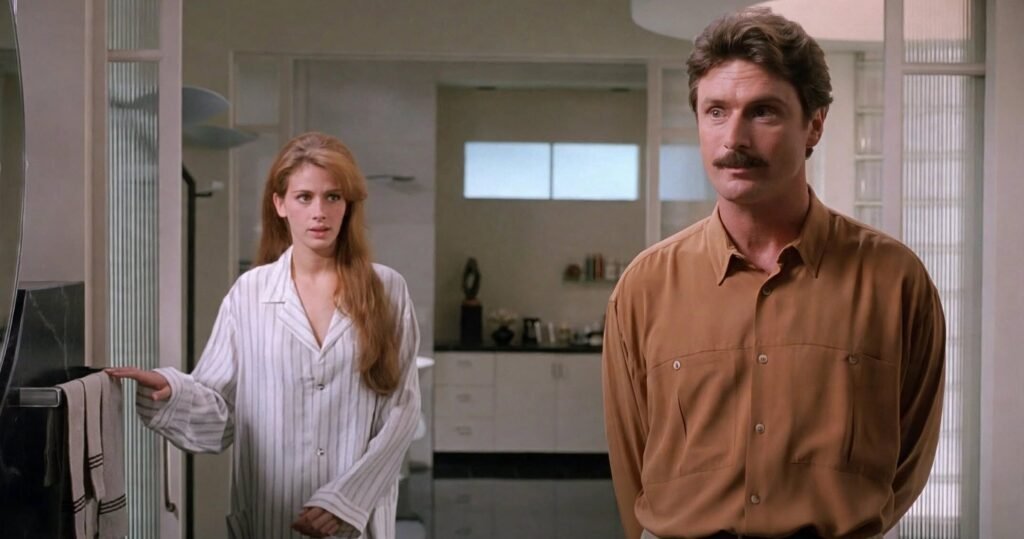
The terror doesn't start with a scream. It starts with laundry. The towels have to hang in perfect alignment in the bathroom, and any disorder becomes the pretext. The cans in the cupboard have to face outward, in the same order, and the order has an owner. Ruben shoots the beach house like an immaculate showroom, and it is exactly the perfection that frightens you.
Patrick Bergin's Martin doesn't need to raise his voice for most of the film. He governs by weather. Laura learns to read his mood from the sound of the key in the door, to anticipate the mistake before it happens, to fold herself smaller before the blow lands. Anyone who has lived through something like this — or stood close to someone who did — recognizes the mechanism: the person stops asking "is this fair?" and starts asking only "how do I prevent the next one?"
The most uncomfortable question in the film
Which is how the movie arrives at the question that probably explains why we still talk about it: how does a woman get to the point where the only exit she can picture is her own death? The film answers without a speech. When you have no money that is yours, no friends who still pick up the phone, no place to go, and every imagined escape ends with him finding you, the door closes from the inside.
Laura doesn't fake her death out of theatrical despair. She does it because, in the arithmetic she can do, staying is worse and leaving for real looks impossible. So she plans the one disappearance he can't follow. And what is most ingenious — and most painful — about the script is that the plan requires patience. She, whom Martin believes cannot swim, learns in secret. Every lesson is an act of quiet resistance performed under the nose of a man who controls everything. When the storm comes and she goes over the side of the boat, what you feel isn't the thrill of an action heroine. It's the cold of a woman who can only imagine freedom in the shape of an absence.

The second prison
The title warns you, and the film insists on it: the fake death isn't the end of the story, it's the beginning of a second confinement. Laura becomes Sara Waters, cuts her hair, moves to Cedar Falls, Iowa, and still carries the glass house inside her. She checks the doors twice. She aligns the towels out of reflex. She flinches at a sound that means nothing to anyone else. He stopped watching her; she never stopped being a hostage. The forged death solved the problem of the address and left the problem of the fear exactly where it was.
What gives her away
There is a detail that almost slips past, and it is the most disturbing thing in the movie. What exposes Martin — and then exposes Laura to him — is not a slip. It's love, and it's a signature. She visits her blind mother, and a receptionist's phone call is all it takes. And then there are the cans in the new kitchen, labels facing out, in the same order, which tell him everything he needs to know. Control is a fingerprint. It leaves marks on the person who was controlled long after she has changed her name.
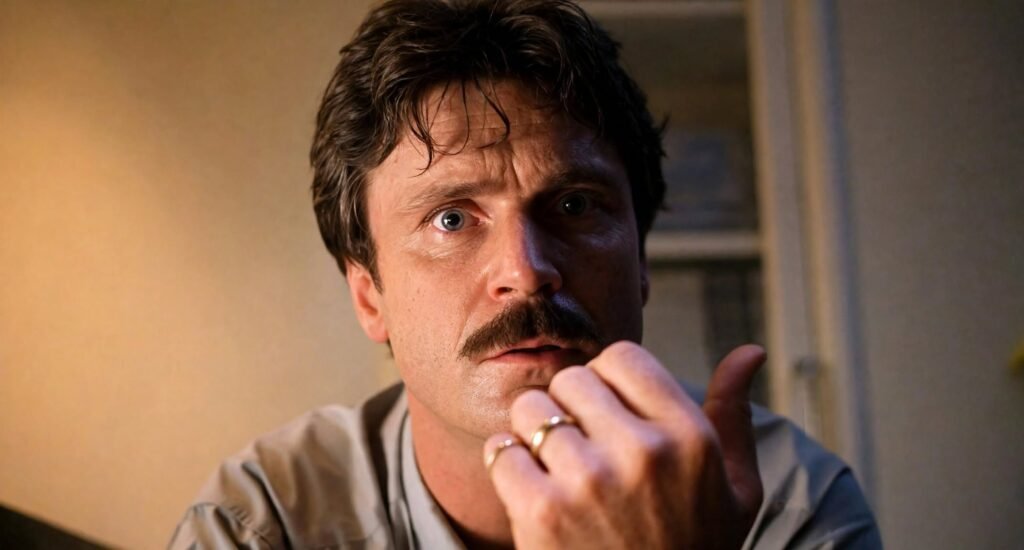
That is why it is a mistake to file the behavior under "quirks" or "jealousy from someone who loves too much." Ruben shows it as what it is: the first layer of a danger that only grows — the rule, the calculated humiliation, the isolation, the system that precedes the punch and makes it possible.
The ending, and why it is a lie
Here is the part an appreciation tends to skip. The film does not let Laura simply vanish. Martin finds her, and she knees him, takes his gun, calls the police — and tells the dispatcher she has just killed an intruder. Then she shoots him three times. It isn't self-defense in any legal sense. It's a verdict, delivered by the person he spent four years convincing she was property.
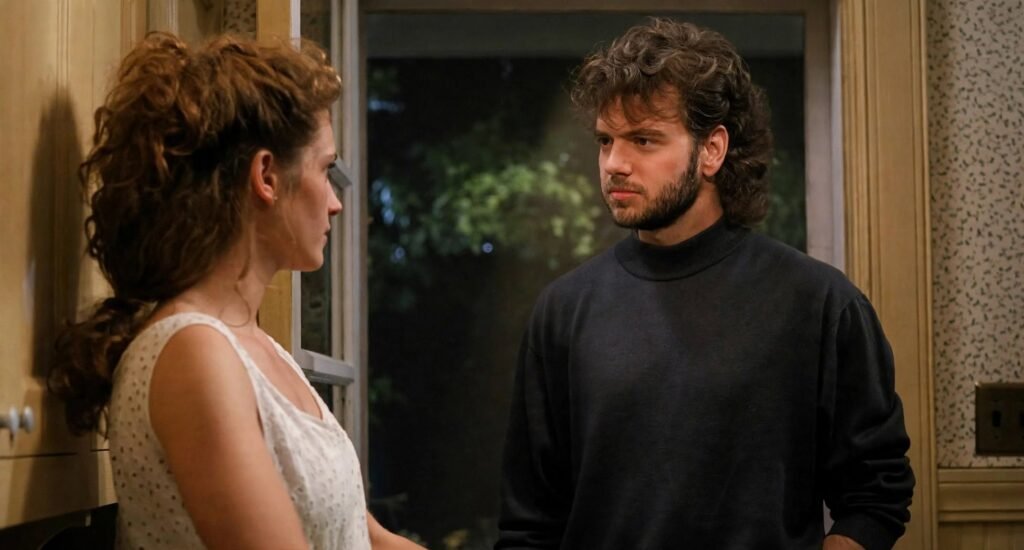
It is also the film's biggest lie, and it knows it. The reviews at the time were mostly hostile — 24 percent on Rotten Tomatoes — and much of the objection was exactly this: that a story about the machinery of abuse gets resolved by a gun in the last five minutes, giving the audience a catharsis that almost nobody gets in life. Fair complaint. But the machinery is the part the film gets right, and it gets it right in towels and cans and the sound of a key.
The question worth asking
So the film survives as a portrait more than as a thriller. And it still functions as a warning, because the moment a woman decides to leave is often the most dangerous point in the cycle, and because the question people ask from the outside — "why didn't she leave sooner?" — is the wrong one. The right one is "what kept her?" The answer almost always includes real fear, real dependency, and a support network that someone deliberately dismantled.

Laura saves herself because she acts. But she also saves herself because she finds one person who takes her in without demanding an explanation — Ben, the neighbor, played by Kevin Anderson, who in the film reads as a romance and in retrospect reads as the whole point. A nod, an open door, a person who believes you. Sometimes that is the entire difference between a plan to disappear and a plan to begin again.