First Knight: The Kiss Everyone Remembers Isn’t the Point of the Movie
How a 1995 armor-and-sword blockbuster turned into a story about a king who loses everything — and why the kneeling scene rewires the whole film. Malagant orders King Arthur to his knees, in front of the army Arthur built. And Sean Connery does it — slowly, the way a man sets down something heavy — before standing again. Most viewers remember First Knight for a kiss that never happens. The kneeling is the movie.
Camelot, Built Next to a Reservoir
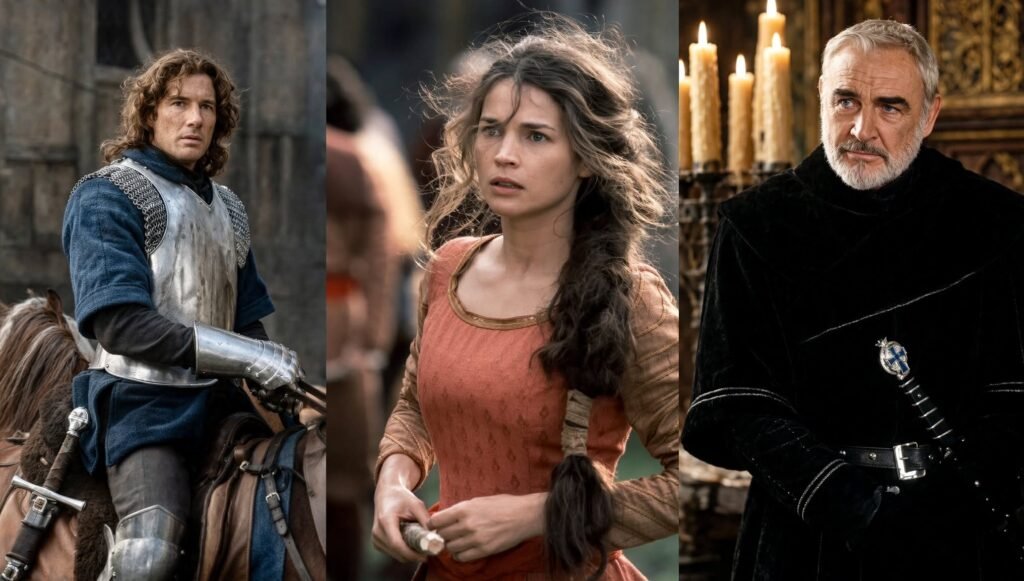
Camelot did not exist, so Columbia Pictures built it: a castle, a round table, a working village on the shore of Lake Trawsfynydd, in the slate hills of Gwynedd, North Wales. Seventy percent of the film was shot outdoors. When the English sun actually came out, the crew fogged the set and sprayed it down to bring the rain back.
Over 3,500 people answered an ad for 1,000 extra roles. Wardrobe counted 300 suits of armor for men and 200 more for horses; battles ran to 200 horses and 250 riders. Richard Gere did his own fencing and nearly all his own riding under Bob Anderson — the sword master behind The Princess Bride, Highlander and the Star Wars duels — and later described a chipped tooth, a concussion and, when his horse bolted, stitches above his eye.
This is the texture you remember from the summer of 1995: weight. The film opened on July 7, third place behind Apollo 13 and Species, with Braveheart still playing two towns over. You didn't stream it; you chose it at a counter. And Camelot arrived in wool, leather and mud — solid enough that decades later you can still feel its weather.
A Kiss Asked to Do a Love Scene's Job
Under the armor, director Jerry Zucker stripped the legend bare. No Merlin. No Excalibur glowing in a lake. No Morgan le Fay. "I never felt a need to be faithful to the legend," he said — he wanted Camelot to be a place people would want to visit, and the battles to read as "dances, not bloodbaths."
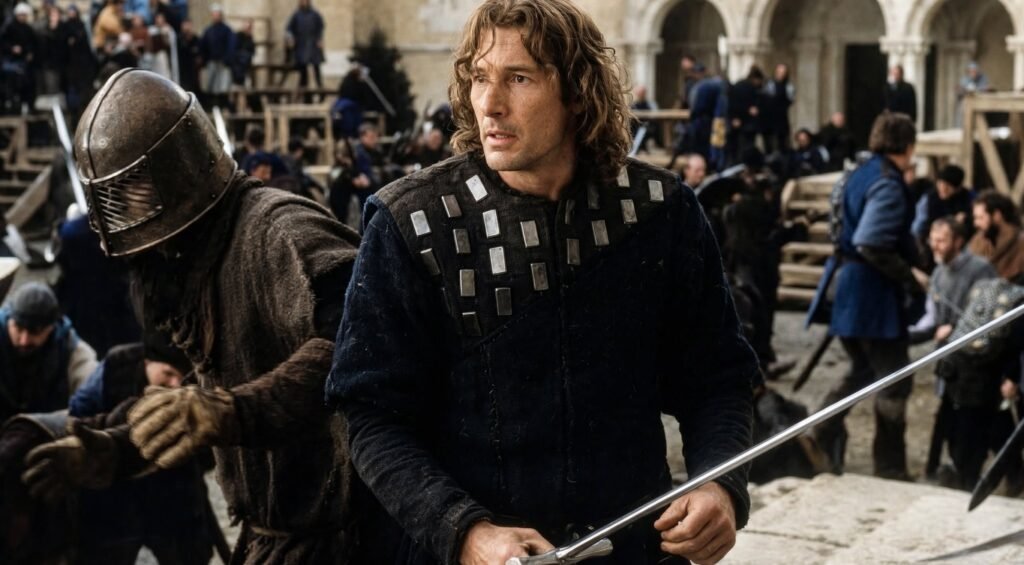
The romance was engineered just as deliberately. Julia Ormond has said she asked about "the romantic level" before accepting the role — and that Zucker wanted the betrayal to turn on a single kiss, not a consummated affair. One mouth touching another has to topple a kingdom. So the film teaches you to lean in: Lancelot's rule — no second kiss unless she asks for it — becomes the most charged line in a movie full of swordplay.
Even the credits were rewritten. A production script dated January 12, 1993 lists Bo Goldman as writer, with Lorne Cameron and David Hoselton; the film that opened in July 1995 credits William Nicholson with the screenplay, and Nicholson, Cameron and Hoselton with the story. Before a single horse was saddled, the movie had already been taken apart and rebuilt under another name. It never quite stops deciding what it is.
Rewatching: This Was Never Lancelot's Story
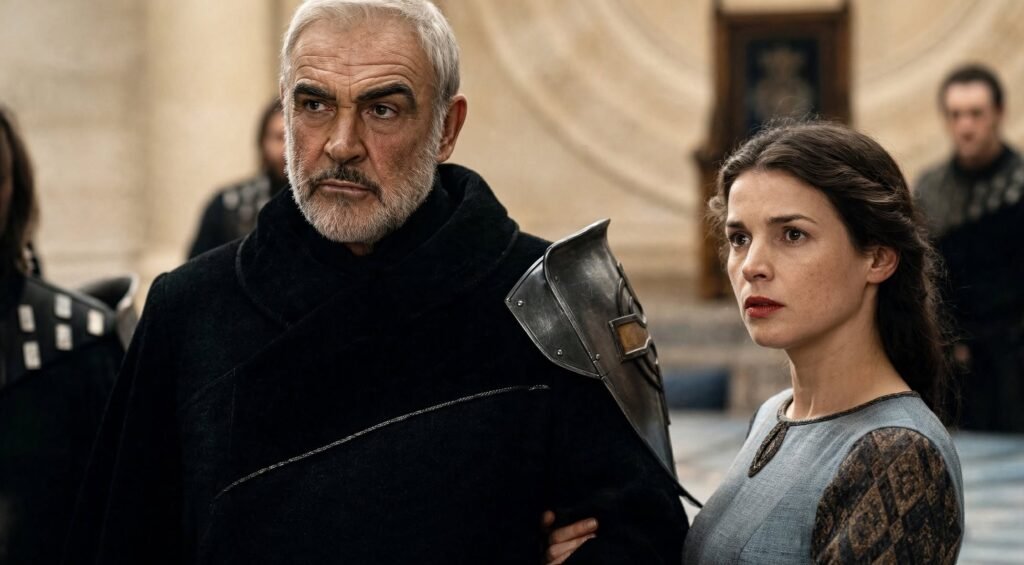
Here is the turn. You came for Richard Gere — the smile, the jaw, the love triangle. Gere prepared by watching Yojimbo: Kurosawa's ronin, a man who trusts nobody, good or bad, and lives by his sword. His Lancelot arrives as a paid drifter who fights for money and believes in nothing. The film puts him on every poster. Then, quietly, it hands the story to someone else.
The King Who Kneels
Watch what happens to Arthur. He is 65 — Connery said he hadn't expected many more leading-man parts at that age — and he knows the arrangement he invented is straining. His Round Table means nothing if its rules stop at the castle gate. Camelot is only an idea, and ideas don't hold swords.
So the film gives him the scene everything else orbits. Malagant forces Arthur to his knees before his own knights. Arthur kneels, rises, and turns to the men who watched — the fight becomes his answer. He loses Guinevere's heart, he loses the battle, he dies. The movie treats the loss as victory.
Notice where the last image goes. The famous kiss — "I owe you a kiss. I'm asking you" — happens midway, as a goodbye. The film ends with Arthur set adrift on a funeral raft, telling Lancelot in his final seconds that he can feel the sunlight. The man who gets the girl is not the one the camera mourns.
That ending reads differently now. In the summer of 1995, the country still borrowed JFK's Camelot for its own White House, and audiences liked believing a table where nobody outranked anybody else might be built for real. Today we'd call Arthur naive. The quieter argument survives the irony: you don't keep your ideals because they work. You keep them because they're yours.

What You Keep When You Don't Get It
Lancelot's promise — no kiss unless she asks — is a small, almost ridiculous vow, and it is the most human thing in the film. The decision to leave something you are allowed to take. Arthur dies with Guinevere's fidelity but not her love; Lancelot wins her love and rides away with it; Guinevere alone gets to choose what stays. Nobody ends up with everything. That is the point.
Most of us will lose something the way Arthur loses Camelot: not in one blow, but in the slow realization that the arrangement we built for everyone else no longer includes us. A job. A marriage. A version of ourselves we can't get back to.
First Knight offers no way out. It offers something smaller: a man setting down his pride on purpose, standing back up, and spending what's left on somebody else's future. Not because it works. Because it's the only move that's still his.
The kiss is what you remember. The kneeling is what stays. Somewhere past thirty you rewatch the film and realize you had been rooting for the wrong man — and that it had already told you, in sunlight, what winning looks like.