The Silence of the Lambs: Oh, Honey, It Just Gets Worse
On Valentine's Day 1991, a movie with no franchise, no Oscar campaign, and a poster that gave away nothing opened in theaters. Audiences walked out silent. The silence never left.
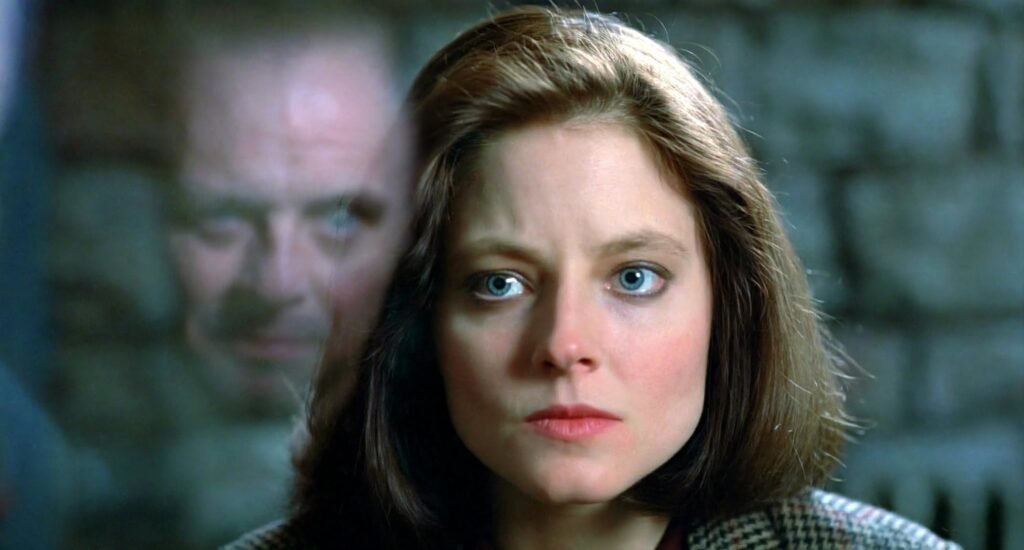
Orion Pictures was broke when The Silence of the Lambs reached theaters. The studio that had made Amadeus and Platoon was coming off a run of expensive failures, and the bet of the year was somewhere else: Dances with Wolves, by Kevin Costner. Jonathan Demme's thriller, shot in the winter of 1989 into 1990, got pushed to February — far from awards season, on a date nobody would pick for an ambitious film, and which happened to be Valentine's Day.
Except that, months earlier, a test screening had already said what was coming. In September 1990, Orion received the report from screenings in Chicago and Boston, more than four hundred people in each city. Audiences had liked the movie, and mostly they had liked him: Hannibal Lecter. Some said outright that they appreciated the fact that the doctor escapes at the end and gets his revenge. No studio in its right mind reads a report like that and doesn't move the release up. Orion moved up what it could. But what made the movie happen wasn't marketing. It was what happened inside the theaters — and one sentence spoken in a lobby in Connecticut.

The 7:10 Show
On Friday, February 14, Art Almquist, a drama teacher at a small boarding school in Connecticut, rounded up two colleagues to see the week's new release. The school sat in a tiny town, and getting to a city with a movie theater meant a half-hour drive: any trip to the movies became a small event. Almquist was a horror fan. Mary, one of the friends, hesitated — she had a hard time with movies that show violence against women. He tried to reassure her with the director's résumé: Demme, the guy who made Married to the Mob and Stop Making Sense, wasn't going to go too far.
The three of them walked into a packed house in Torrington for the 7:10 show. The theater was also playing Home Alone and King Ralph on its other screens. More than an hour into the movie came the scene where Buffalo Bill taunts Catherine Martin, trapped in the well, and the two of them scream at the camera. Mary got up and went out to the lobby.
A woman working the concession stand saw her standing there and asked what she was watching. Mary told her, and told her what scene she was at: the girl in the well, and him imitating her screams. The woman shook her head. "Oh, honey, it just gets worse." She hadn't seen the movie. She'd heard it through the wall for weeks. That was all she needed to know where the story was going.
The Silence Was Designed
What those audiences did was what the movie asked for. A theater manager in Los Angeles told the press he hadn't heard anything but silence when people walked out, and that they came out emotionally drained. It wasn't respect. It was exhaustion.
Demme built that into the sound. He traded the synth stabs and discordant noise that were the standard kit of 1980s horror for a slow, heavy orchestral score by Howard Shore. For Clarice's first visit to Lecter's cell, his instruction to sound editor Ron Bochar was literal: "This is the bowels of the building. Let me hear howling and let me hear bowels." Bochar packed the track with barely audible animal noise — including screams he had recorded for Little Monsters, a 1989 family comedy with Howie Mandel, here slowed down and reversed.
Nobody in the audience would have identified any of it. But according to Bochar, whenever the scene went down to Lecter there was a low tone that rose and then came down again, and the body registered the pressure without the ear understanding it. That's why the lobby felt like a refuge.

The Poster That Told You Nothing
Before the movie reached theaters, the campaign already said what it wasn't. Orion's marketing chief, Charles O. Glenn, summed up Demme's ask: no cheap serial-killer movie, no Texas Chain Saw; a campaign that said "This is a theatrical experience that you do not want to miss. It is formidable. It is frightening."
Designer Dawn Baillie was given stills from the film and the script — no moving footage. She picked a close-up of Jodie Foster, covered Clarice's mouth with a death's-head hawkmoth, and turned the insect into a symbol: the skull on its thorax was made of seven nude female bodies, a motif already circulating in the campaign material, borrowed from a Salvador Dalí portrait shot by Philippe Halsman in 1951. For the final art she rented a specimen from the Natural History Museum of Los Angeles County, photographed it, and drew the skull onto the moth's body. She gave Foster's eyes a Day-Glo orange glow. She set the title all in lowercase, in an angular, razor-blade font — "my attempt to feminize the masculine font," she said.
The MPAA rejected the poster: the nude women in the moth were too visible. The fix was to redo the image with seven women in unitards. The result suggested the movie's tone without giving away a single plot point — at a time when audiences found movies through full-page ads in the New York Times and the Los Angeles Times. The trailer took the same route: it opened with Jack Crawford looking into the camera and asking whether she spooked easily, as if the question were aimed at whoever was buying the ticket.

Thumbs Down
Almost every critic praised it. Vincent Canby, in the New York Times, called it pop filmmaking of a high order. Sheila Benson, in the Los Angeles Times, compared Lecter's first appearance to the unmasking of the Phantom of the Opera. Gene Siskel was the loud exception: he called Hopkins's performance way overplayed, the project "surprisingly trashy," the movie a "star-studded freak show" — and swore he hadn't learned a thing about serial killers from it.
On television, Roger Ebert disagreed live: it worked for him, it worked. Siskel replied that, well, then Ebert was easy. Audiences didn't care. On 1,497 screens, the movie took in $13.8 million over the four-day Presidents' Day weekend, opened at No. 1, and stayed there for five weeks — tied with Home Alone for the longest run at the top in 1991. It finished its domestic run at around $131 million. And by the end of that year it became the first horror film ever to win Best Picture.
The Women Who Joined the FBI Because of Her
Shayne Buchwald, then 19, saw the movie in a small theater in York, Pennsylvania, with her boyfriend — "a big guy who looks like Spencer Tracy," as she remembers him. At the scene where Clarice finds the deformed head of one of Lecter's former patients in a jar, he got such a scare that he elbowed her in the face and made her nose bleed. Buchwald grabbed a tissue, stuffed it up her nose, and sat there with it for the rest of the movie. She wasn't going to miss a minute.

She joined the FBI in 2002 and spent more than two decades at the Bureau, focusing on violent crime. On red-eye flights between California and Maryland, when the crew found out what she did for a living, the nickname came: "Clarice, you want some more water?" After she retired, in 2023, she had the moth from the poster tattooed on her left arm. She still watches the movie every year, on the anniversary of the day she entered the FBI.
Buchwald wasn't alone. Female agents went in groups, argued about it at length, and in a letter to the producers, agent Athena Varounis reported the verdict: you would not have found a more critical audience anywhere, but the movie was voted "four and a half guns" out of five. Mary Ann Krauss, raised in Mississippi, got stuck on Foster's accent: "I was like, 'Holy moly — was she recording me?'"
Outside the Bureau, the effect was stranger. A New York psychologist said nearly a third of her male patients wanted to talk about Lecter, and that some of them had lost three or four nights' sleep. Diane Baker, who played Senator Ruth Martin, spent decades hearing strangers repeat the sharpest line from her scene with Hopkins. Once, in a corridor at Memorial Sloan Kettering, a nurse pushing a gurney stopped, looked at her, and said, "Love your suit." Baker stared in horror at the patient on the gurney.
The Whole Country Had It
In 1991, the movie was everywhere. Hopkins landed on the covers of Newsweek and Entertainment Weekly, which called him "the scariest man in movies." Saturday Night Live did a sketch with Jeremy Irons, who had been on the original wish list for the role. Jay Leno brought out a fake cookbook on Johnny Carson's show: How to Eat Friends & Digest People. NBC dug up Michael Mann's Manhunter, retitled it Red Dragon: The Curse of Hannibal Lecter, and promoted it with a growling voiceover promising that "Hannibal the Cannibal is coming to your house Friday night." President George H. W. Bush opened a speech at the FBI Academy in Quantico by saying he might have spotted Hannibal the Cannibal in the audience.
Hopkins, at 53, found out what fame was in a way nobody plans. Driving down Sunset Boulevard, he saw a huge billboard for the movie with his name on it. He pulled the car over and just looked at it. He laughed.

Back to the Well
Thomas Harris, who wrote the book, has never watched the movie. His mother did, at a theater in Memphis, and told a reporter she wasn't easily scared. The rest of us were. And more than thirty years later, what stayed isn't the scare: it's the silence. The girl in the well is still screaming, the monster is still imitating the scream, and the woman at the concession stand is still right. It just gets worse. The movie hasn't aged because its fear isn't in the blood. It's in the waiting.
If you go back to it now, try the lobby test. In the basement scene, when Clarice walks down to Lecter, turn the volume up and listen underneath. You won't be able to identify the screams that are in there — they come from a 1989 family comedy and they're playing backward. You'll feel them. It's that tone, rising and coming back down, that sent a whole theater out mute in 1991, and that still keeps us listening to the movie after it ends.