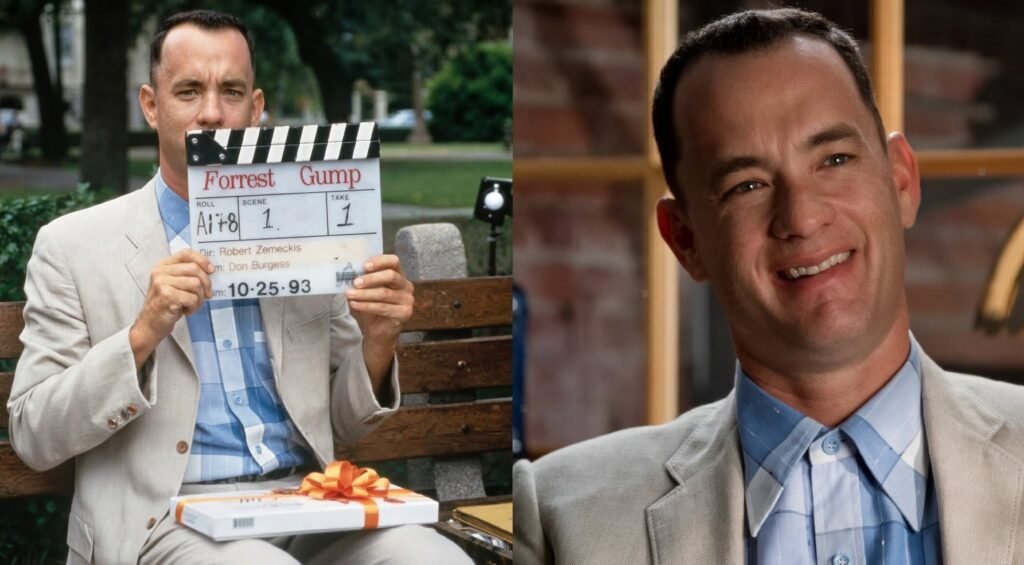
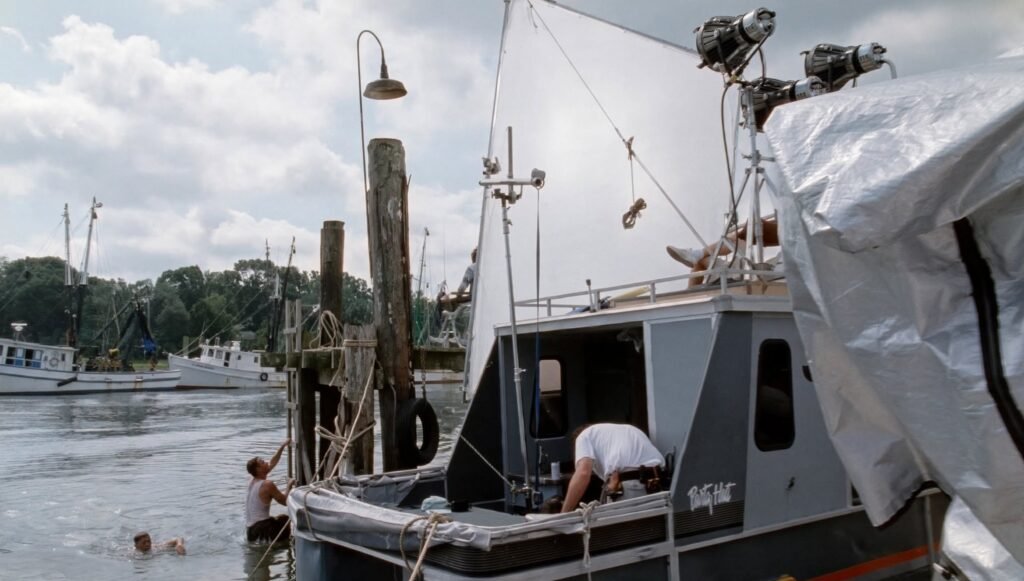
Tom Hanks pulled back the curtain on one of Hollywood’s most technically demanding shoots in a behind-the-scenes conversation about the making of Forrest Gump, and the dialogue is worth revisiting precisely because so much of what he describes sounds impossible on paper. Reprising his account of the production, Hanks explained that filming anywhere near boats and open water is the hardest work in movies, since everything floats, drifts, and moves with the sun, wind, and currents — and that director Robert Zemeckis solved the problem with a flotilla of barges and tugboats, a scheme Hanks admits he was sure would never work. It did, and that mix of awe and exasperation runs through his entire recollection. The actor also makes clear he prefers shooting on location to working on Hollywood soundstages, arguing that a strange place keeps the cast focused and drags real local color into the movie.
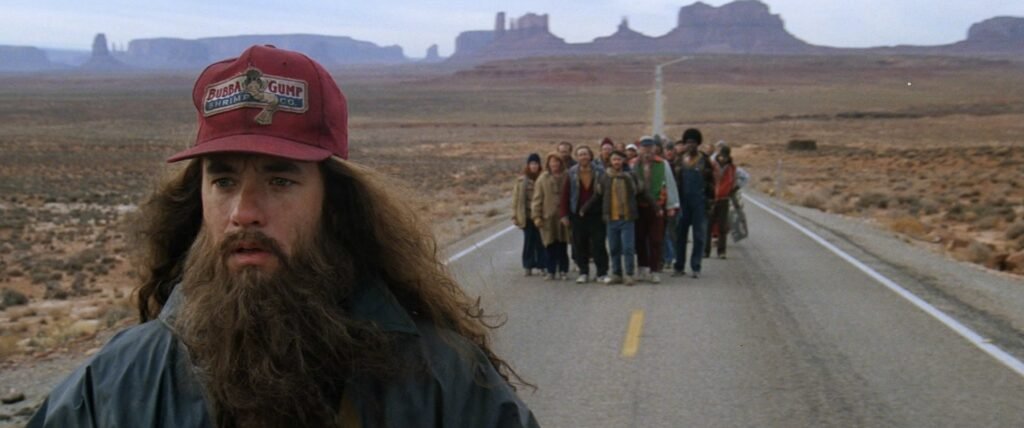
All of that technical sweat served a story that unfolds as a chain of tall tales told by a gentle, slow-witted Alabamian whose accidental presence at nearly every major event of late-20th-century America turns him into a quiet witness of history. Forrest is bullied as a child and protected by Jenny, the girl next door whose path repeatedly crosses and diverges from his; he survives a brutal childhood thanks to leg braces that eventually come off in a sprint, earns a college football scholarship, serves in the Vietnam War, befriends Bubba, loses Lieutenant Dan’s legs and his own innocence in the same jungle, comes home to build a shrimp fortune, marries Jenny, and raises a son. Around that spine sit the moments everyone remembers: the feather drifting down to his bench in Savannah, the cross-country run that draws a growing crowd of disciples, the ping-pong matches that make him an unlikely celebrity, and the running gag of his mama’s advice that life is like a box of chocolates — a philosophy Forrest delivers to strangers on a bench while waiting for a bus.
Much of Hanks’s commentary centers on the Vietnam sequences, which were staged not in Asia but along the islands of Beaufort, South Carolina, where locations like Fripp Island happened to resemble Southeast Asian terrain. The danger was real: during the napalm explosion scene, Hanks had to hit his mark a few feet in front of the wall of gas flames with no room for a misstep, and he jokes that after such close calls he will leave the stunts to stuntmen from now on. He also describes carrying his co-star Mykelti Williamson through the jungle rescue of Bubba — a task so punishing that crew members rigged harnesses and monofilament lines, then kept adjusting the weight until Hanks could run believably without his scene partner floating like a “feathery sack.” To keep the war material from sliding into camp, the production brought in veteran military adviser Captain Dale Dye, who put the actors through three days of living in the jungle, short by the standards of the multi-week boot camps he ran on films like Platoon.
The retrospective also gets into the small-scale movie magic that gave Forrest Gump its texture. Hanks describes a jet-engine fan pointed at the actors to drive kerosene-exhaust rain horizontal to the ground, the kind of sideways downpour the script called for repeatedly, and he is candid about how unpleasant it was. The ping-pong matches — the ones that send Forrest to China during the Cold War and eventually earn him a meeting with the president — were staged with actors miming play while the ball was added optically, coordinated by a metronome so the two players never swung at the same time; Hanks found it exhausting, especially going against a world-class opponent who had never played without a ball before. Even the boarding house at Oak Alley was built from scratch on the site of a real house that had burned down years earlier; when Sally Field first saw it, she was startled to learn it wasn’t an existing plantation home.
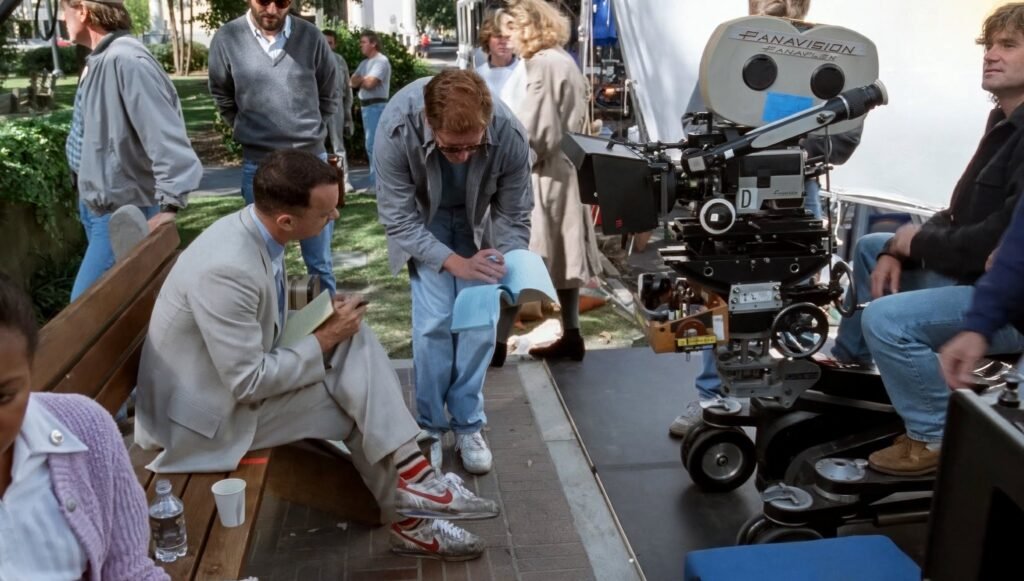
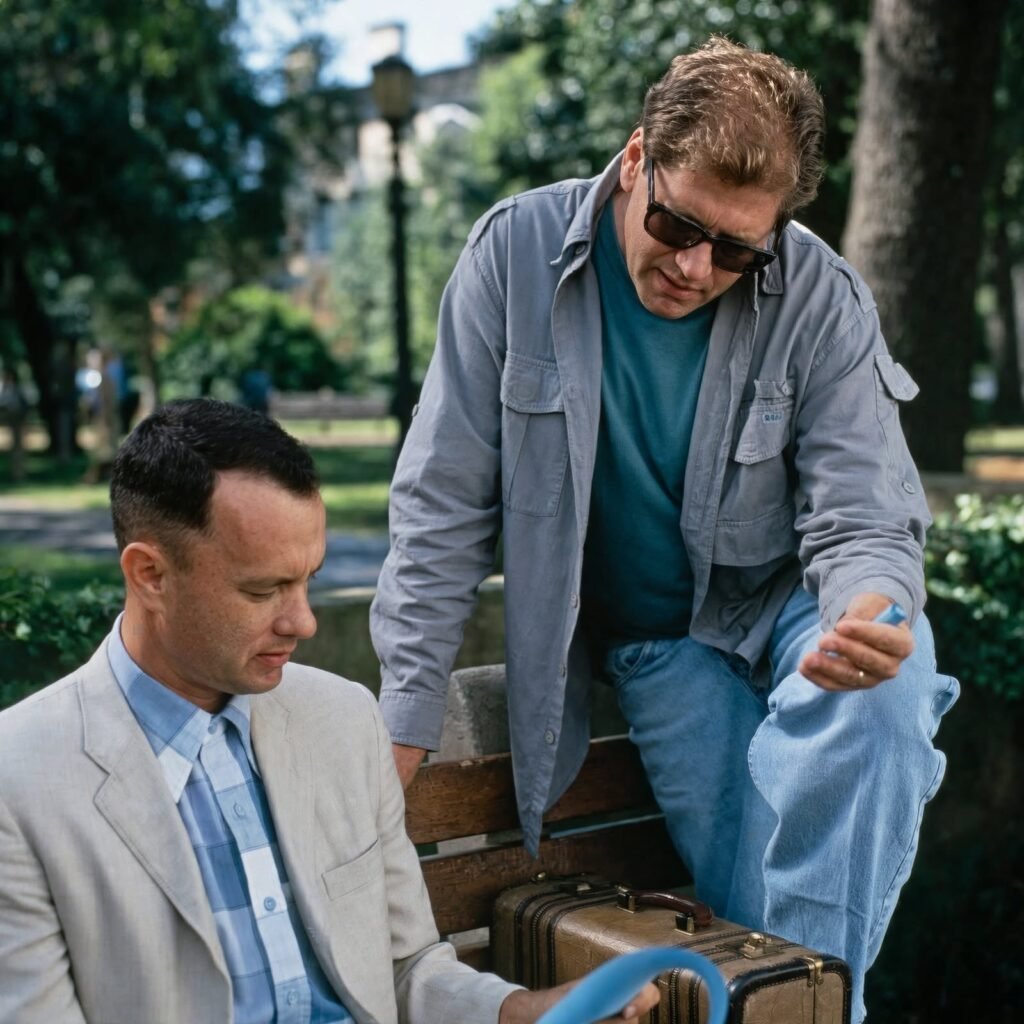
One of the most revealing passages concerns the narration that stitches the film together. Zemeckis decided against recording the bench monologue in a studio later, as is standard, and instead had Hanks perform all of the voice-over on camera midway through production, in the real locations, connected to images the crew had already shot. Hanks says he resisted the idea at first, expecting they would just have to redo it, but came around: by the time cameras rolled, the reams of cue-card dialogue felt so tied to pictures he already knew that he barely needed the cards, and the last thing he wanted to do became the most fun he had on the movie. It was the right call for a film whose entire structure depends on that voice — every leap from the Vietnam jungle to a shrimp trawler to a transcontinental run only lands because Forrest is the one telling us it happened, with Jenny’s story threading through it all as the one tale he can’t narrate his way out of. That performance helped seal the film’s sweep at the Oscars — Hanks won back-to-back Academy Awards for Philadelphia and Forrest Gump, a feat only Spencer Tracy had matched — and the narrative shows exactly where that work was done: on a bench, in the moment, rather than in a recording booth months later.