Mad Love (1995): The Teen Romance Disney Cut Apart
Mad Love (1995) asks you to do one thing first: look
A boy named Matt scans the night sky from a house across the lake, in a Seattle suburb, hears a noise, and swings his telescope down to the water. What he finds is a girl riding a jet ski across the dark water. He doesn't know yet that she's Casey, the new girl from Chicago who is about to walk into his high school. Hold on to that image, because the movie spends the rest of its running time doing to us what it does to Matt. It shows us a girl at the brightest moment of her night and lets us fall for the glow.

What Mad Love was sold as — and what Antonia Bird made
The movie itself was introduced to the world in much the same way. In the spring 1995 issue of BOMB, published that April, Antonia Bird described the film she had just finished for Disney: "It's a very unusual film for Disney, it feels like an independent film. It deals with a first teenage sexual relationship and becomes a very strong, and quite tragic, love story." The girl, she said, had been psychologically damaged by her parents and was, unbeknownst to herself or anyone else at the start, suffering from a clinical form of depression. The boy and girl break out of their middle-class Seattle background, run away, and travel toward New Mexico. "At first, they experience a wild euphoria of freedom. Then, her psychological problems take over."

The studio's own synopsis sold something else entirely: "the wild and sexy story of two passionate young people who take to the road for the incredible adventure of their lives."
The publicity and the director were describing two different movies. That gap became part of Mad Love's history — and, twenty-five years later, the reason people still argue about it.
Opening weekend: Memorial Day 1995
It reached theaters on May 26, 1995, Memorial Day weekend, the opening of the American summer. That weekend Casper was number one with $22 million, Die Hard with a Vengeance was second in its second week, and Mad Love came in seventh with $6.8 million from 1,500 theaters.
Look at the ordinary pages of that week. In Spokane, the newspaper listed it at three named cinemas: Lincoln Heights, North Division and Coeur d'Alene. Its critic, Michael H. Price, wrote that Chris O'Donnell — "soon to be typecast as Robin the Boy Wonder in Batman Forever" — "enjoys a last fling with civilian near-normalcy."
A lot of people walked in expecting a John Hughes movie with a grunge soundtrack, and most of that is what the film gave them. The Los Angeles Times, reading the returns, put it more bluntly: teenagers "flocked" to the film, "though the weepie looks to have wobbly legs."
They were right about the legs.
The cut nobody could see (until the Blu-ray commentary)
Some critics noticed that something was off at the edges. The Baltimore Sun's Stephen Wigler wrote that "the film limps to its conclusion, suggesting either that an original ending had been re-shot or that Bird did not know how to conclude matters."
He couldn't have known how right he was
The Blu-ray commentary by journalist Bryan Reesman later laid out the story. After the controversy around Bird's previous film, Priest, the studio cut Paula Milne's script and Bird's final cut, softening the material on mental illness and teen suicide and reducing Casey's illness to depression, when her symptoms point to bipolar disorder.
And that controversy was not distant background. Priest, a film about gay priests, had opened in the United States that March; Catholic groups forced Miramax — Disney's subsidiary — to move its wide release off Good Friday, then took their boycott to Disney itself. Bird was finishing a teen film for the same company while that boycott was running.
"We always thought we were making a film for 15 and up," she said afterward, "and suddenly we had to make it for PG. Which meant I had to take the heart of the film out."
A 1995 critic had sensed the seam. A 2019 audio commentary showed where it was.
A release date that ran out of time

The film also had a clock running against it. Variety's Emanuel Levy wrote that the picture "may have fared better had it been released after Batman Forever," in which O'Donnell plays "the major role of Robin and Barrymore has a supporting part."
By its second weekend Mad Love had fallen to ninth place with $2.4 million, down 65 percent, with Batman Forever due on June 16. It finished with $15.4 million. By the standards of the summer of 1995, it passed through the cinemas quickly.
Why Mad Love still holds up
What stayed behind is the film itself, and a lot of it is still vivid. It was shot from June to August of 1994, in the Seattle area and in New Mexico.
It is a very Seattle movie in sound as well as in setting: 7 Year Bitch filmed their club scene at Seattle's Club Moe that July, and two of their songs, "The Scratch" and "Icy Blue," made the album. The soundtrack mixes Magnapop, Rocket from the Crypt and Grant Lee Buffalo, and the film uses Nirvana's "Love Buzz," which isn't on the record at all.
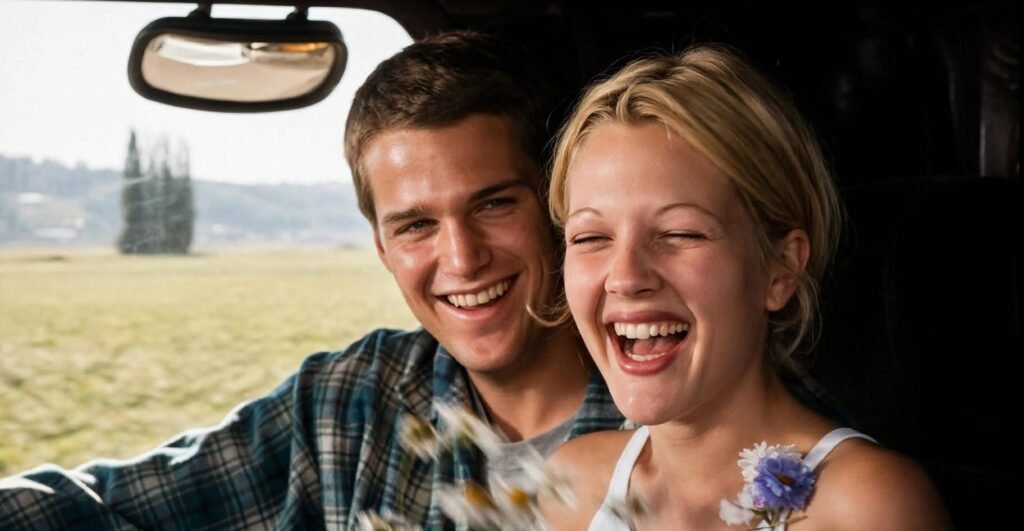
Then there are the scenes people actually remember. Casey pulls the school fire alarm to get Matt's attention during his SAT. She covers his eyes and guides him through a "trust game" while he drives, and the car ends up wrecked. They run toward Mexico, and as her moods turn, Matt slowly realizes that loving her is not the same as being able to help her.
The road trip the poster advertised becomes a different kind of journey, and the film becomes most itself in the stretch that no advertisement could have sold. Roger Ebert saw it. The movie, he wrote, "is not the first movie about two troubled kids who hit the road in an attempt to run away to their dreams. But it's the first one in a while that turns realistic, and shows one of the kids trying to react responsibly when the situation gets out of hand. That makes it more interesting, because it's about real problems, not movie problems."
The 2020 reunion and the 2026 poster recreation
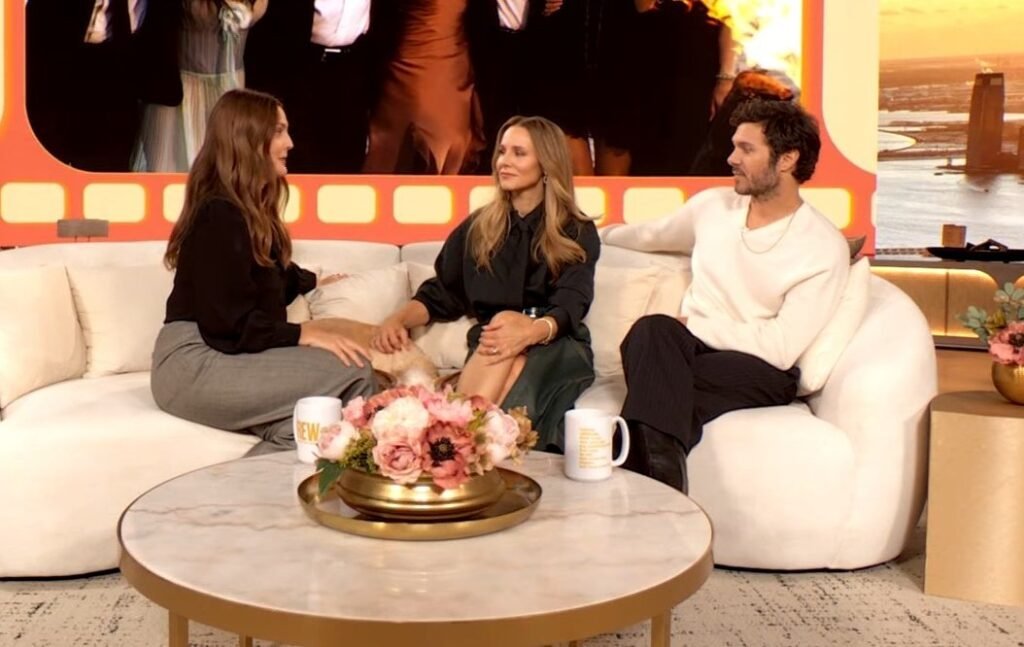
That is probably why it didn't disappear. In November 2020, twenty-five years later, the two leads reunited on Barrymore's talk show. She remembered how wild she was in those days, cutting her own hair with scissors; he remembered her photographing clouds with a Polaroid for no reason.
He also admitted he had never watched the finished film. "People, especially young girls, always come up and go, 'I love that movie, it was so amazing,'" he said, "and I'm thinking, 'Thank you, I can't comment. I don't know how it ended up turning out.'"
The movie has lived on in people who saw it, even though the people who made it have trouble watching it. The first Blu-ray came from Kino Lorber on December 17, 2019, with Reesman's commentary on it.

And on the November 13, 2026 episode of the show, the two climbed onto a table — the poster has them perched on a car — Barrymore in a blonde wig, and O'Donnell held her there. "Come on, you're not falling," he said. "I think I can still hold you here." Then he pulled her back into a hug and she cheered, "I felt freedom!"
Whatever was cut, the first shot survived. A boy puts his eye to a telescope, a girl crosses the dark water, and everything that follows is the price of having looked.