7th Heaven: They Declared the Family Hour Dead. Then the Camdens Moved In at 8 p.m. on Mondays
The first thing 7th Heaven ever shows you is a bedroom door that will not stay closed.
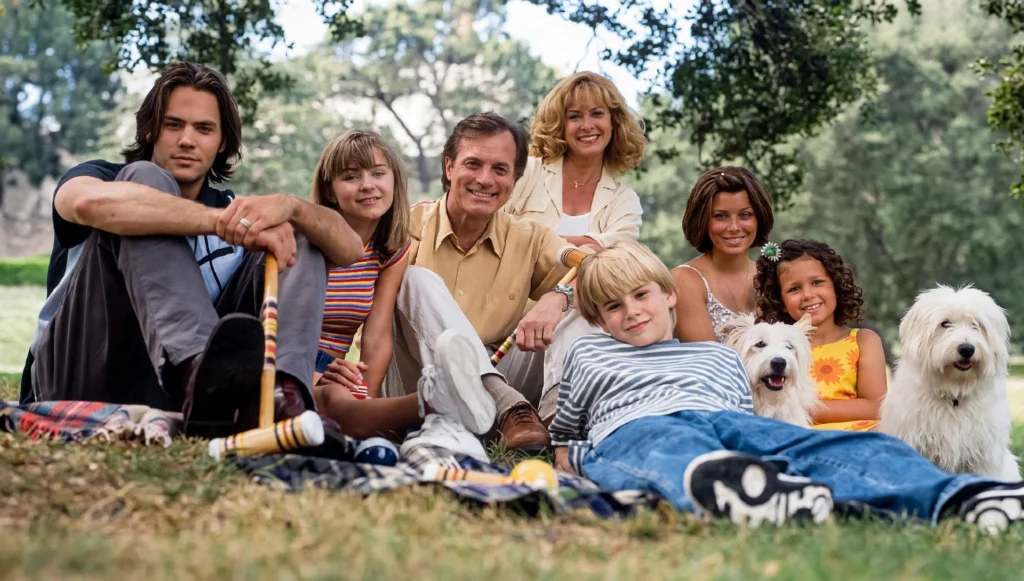
It's Saturday. Eric and Annie Camden are trying to have a moment. The kids start filing in one at a time — a whole army of interruptions — until the bed is full and Ruthie, the youngest, asks the question that became her signature: what are we doing? Decades later the cast would remember that scene as the one that set the tone, because it told you in two minutes exactly how many people lived in this house and how little privacy any of them had.
It aired on Monday, August 26, 1996, at 8 p.m. It was the first Monday-night programming The WB had ever broadcast, and the show would hold that slot for ten seasons without ever moving — the longest run in the history of a network that only lasted eleven years itself.
The timing is the part you can't make up

The year before, Bob Dole went to Hollywood on May 31, 1995, and used a speech to go after the entertainment industry. He named Time Warner as his main target, accused it of "marketing evil through commerce," and called the whole thing the mainstreaming of deviancy. That fall, a U.S. News piece — later quoted into the Senate record — declared the old "family hour," the early-evening block where everyone in the house could watch together, effectively dead.
And the fight was live before the Camdens arrived. In May 1996, three months ahead of the premiere, a bipartisan group of congressmen publicly asked the six major networks to cleanse the 8-to-9 p.m. hour of what they called promiscuity and obscene language, and to bring the family hour back.
Then, seventeen days after that first Monday, Senator Joe Lieberman introduced S. Res. 290 — a formal request that the networks "revive their traditional Family Hour" and voluntarily reserve the first hour of prime time for family programming. He said he wanted to watch television with his wife and eight-year-old daughter without being embarrassed.
The Camdens were not a response to any of this. They were already on the schedule. They just landed exactly where the argument was happening, in the exact hour Congress was arguing about, on the one network nobody was watching yet.
Nobody designed it

What's remarkable is how little grand design there was.
Brenda Hampton was a sitcom writer — Blossom, Mad About You — who had never written an hour of drama. She took the pitch meeting mostly because she wanted to meet Aaron Spelling. She didn't start writing the pitch until the night before, and finished it on the way there.
Eric the minister wasn't a thematic choice. He was a nod to a friend in New York who was both a minister and a family counselor; Annie was named for that friend's wife, a former NBC colleague. The network itself said the pastor thing barely mattered — Eric's job isn't even revealed until halfway through the pilot.
Even the two people who ended up as Eric and Annie hesitated. Stephen Collins' agent warned him off for three reasons: a brand-new network, a producer famous for glitz, and a family show. Catherine Hicks had always said she would never play a mother, because mothers never got real material. What won her over was a mother with some humor, and a family that stayed together at a moment when, she felt, families were coming apart.
Hampton's version was simpler. She wanted to make the kind of show she grew up on — Leave It to Beaver, The Donna Reed Show, Father Knows Best — so she pitched a functional family. The network bought it. She went on to write 114 of the show's 243 episodes herself.
How small it wanted to be

Look at the pilot, "Anything You Want." A girl named Lucy is waiting, anxiously, for her first period. A boy named Simon is waiting, just as anxiously, for a dog. That's the plot.
The dog turns out to be Happy, a shelter rescue with a day left to live. Years later the actors would watch it again and laugh at their own memories: parts of it were shot in Pasadena before the show was picked up and reshot on a soundstage after. David Gallagher, fresh from New York, couldn't say "asked" without an accent, so the take that made it into the pilot is the one where his Simon says it his way. The church scenes were shot in summer heat, and between takes the kids did schoolwork in a back room. They also noticed, rewatching, that the Camdens' house is the church's house — the parsonage. Which is why Eric never had a private jet.
The parsonage is the most American thing about the show: the old idea of the small-town pastor living next door to the church, where the congregation is neighbor and audience at once. And 7th Heaven was careful with it. It never played the angel card the way Touched by an Angel or Joan of Arcadia did. Eric's denomination is almost never named. The faith in that house is practical — you tell the truth, you forgive each other, you sit down to dinner.
Critics noticed the formula: a Camden has a problem, the family gathers, everyone talks it through. They weren't wrong. But nobody watching was there for surprise.
The part the legend leaves out
By its tenth season it had passed Little House on the Prairie and The Waltons as the longest-running family drama on television, had been The WB's most-watched series for seven straight seasons, and accounted for 19 of the network's 20 most-watched hours ever. The record hour was February 8, 1999 — the birth of the Camden twins — at 12.5 million viewers. The network's own researchers liked to point out that Buffy and Dawson's Creek got the press, and the Camdens got the audience.
Then The WB shut down, and 7th Heaven did something undignified and wonderful: it outlived its own network. Cancelled in 2006, it drew 7.56 million viewers for what was supposed to be the finale — the network's best number in a year and a half — and The CW brought it back for an eleventh season, which nobody promoted properly, and it ended in 2007 with 243 episodes behind it.
Why it still works
That's the thing about the Camdens. They were never really about being perfect. They were about being home.
Ruthie opens the bedroom door, Simon makes his case for the dog, Lucy stands on her head and hopes, and everyone, whether they want to or not, ends up in the same room. It's the least fashionable idea in American television and it beat everything around it.
Put on the pilot. Watch the door. Then send this to whoever you used to watch it with on Monday nights.