Beyond the Glamour of Dallas: The Resilience, Rebellion, and Ageless Grace of Linda Gray

Linda Gray has crafted one of the most fascinating trajectories in American television, immortalizing herself as the complex Sue Ellen Ewing on Dallas. Yet, behind the magnetic glamour of the 1980s, her biography holds hidden chapters, unusual paths, and a generous outlook on aging, grief, and the industry. Born in Santa Monica and raised in Culver City, California, where her father worked as a watchmaker, she attended Culver City High School. Before achieving stardom, she worked as a model in the 1960s and shot nearly 400 television commercials. Her entry into entertainment came gradually through small roles until her breakthrough in Dallas. An analysis of her interview reflections reveals several central, lesser-known themes that guide her philosophy of life.
Before bringing the wife of J.R. Ewing to life, Linda Gray’s body had already starred anonymously in one of cinema's most iconic images. She was the body double for the emblematic leg featured on the official poster for The Graduate (1967). For decades, the public assumed the leg belonged to lead actress Anne Bancroft. In an interview, Gray recalled the episode with good humor, sharing that Bancroft was absent from the studio during the promotional photo shoot. Working actively as a model, Gray was hired on short notice to substitute, receiving a modest payment of only 25 dollars. Decades later, her stage career led her to play Mrs. Robinson herself in the London theatrical adaptation, completing a perfect artistic circle. This late revelation shows how invisible steps behind the scenes carry a foreshadowing of destiny, reflecting a work ethic focused on learning that paved the way for her identity to eventually win over the world.
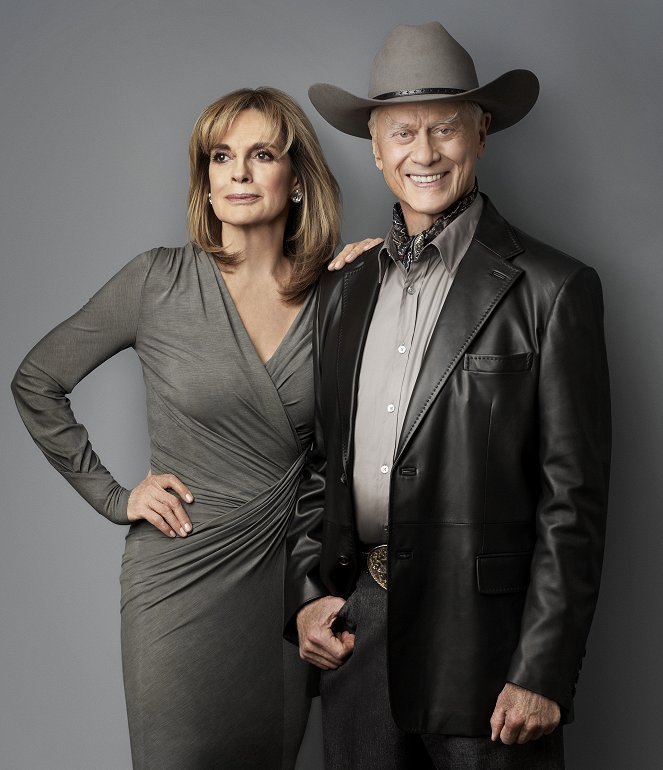
Casting for Dallas transformed the actress's life, but building her iconic character came from painful, intimate references. Far from the glamour of expensive costumes, the dramatic density she brought to the screen was extracted from family experiences. In an interview, Gray opened up about how her father’s severe alcoholism directly affected her childhood. When she took on the vulnerable, self-destructive Sue Ellen, she used this personal baggage to bring truth to the screen, causing millions of viewers to identify with that family pain. Her success earned her respect behind the scenes, and her attention to technical details led her to study directing, becoming one of the first women to helm episodes of her own series during the golden era of American television. Transforming personal trauma into art and leadership power behind the scenes exemplifies her capacity for metamorphosis, refusing the passive role of the suffering wife to take the reins of the narrative.
While the explosive on-screen marriage between J.R. and Sue Ellen became the central hook of Dallas, the real-life dynamic between Larry Hagman and Linda Gray was anchored by a fiercely protective friendship that lasted over 35 years. This alliance faced its ultimate test during the show's eighth season. Seeking equal privileges granted to her male co-stars, Gray pushed for pay parity and the contractual right to direct. When negotiations stalled, production executives abruptly fired her. Upon learning of her dismissal, Larry Hagman took a defiant stand against the showrunners, flatly declaring, "If she goes, I go." Faced with losing their biggest star, the network quickly reinstated Gray, who eventually went on to direct multiple episodes. In an interview, Gray noted that Hagman’s unwavering loyalty permanently shifted the power dynamics on set. This powerful intervention demonstrates that true solidarity in a competitive industry can shatter glass ceilings, proving that their cosmic connection was built on a mutual respect that defied corporate structures.

Having experienced the peak of traditional linear television, where audience ratings were concentrated across just three major channels, Gray’s perspective on the evolution of acting is sharp and welcoming toward younger generations. In an interview, Gray analyzed the fundamental differences between her early career and the contemporary entertainment landscape. She explained that during her golden era, the industry imposed a highly rigid image on stars, frequently trapping professionals in a specific stereotype. Conversely, she highlighted how today’s actors possess greater freedom to act as chameleons, moving seamlessly across multiple profiles and streaming platforms. Rather than showing nostalgia, she celebrates the diversity of opportunities that the modern industry offers to new talent. Maintaining a generous gaze toward the transformations of her own medium demonstrates deep emotional intelligence, proving that her true engine has always been a pure passion for the craft of acting rather than clinging to the past that made her a global household name.
If fiction consecrated her for portraying a woman in constant collapse, reality imposed the most painful test a mother can face. The loss of her firstborn son, television director Jeff Thrasher, to leukemia at the age of 56, completely reconfigured her perception of mortality and resilience. In an interview, Gray shared with profound delicacy the pain of his absence and the way she chose to honor Jeff's memory. Far from closing herself off, the actress revealed that she adopted the habit of taking daily gratitude walks to anchor herself in the beauty of life's ordinary moments. She described her son as the kindest human being she ever knew, choosing to view his passing not as a static end, but as the beginning of a magical journey. This quest to focus on the love left behind became the pillar of her emotional survival. Facing the reversal of life's natural order with gratitude reveals a spiritual strength that transcends any dramatic role, proving that true resilience lies in the refusal to let pain erase the beauty of the world.
The philosophy of staying in constant motion and defying stereotypes about age materialized in one of the most surprising journeys of her maturity: her decision to walk the legendary Camino de Santiago in Spain. In an interview, Gray recalled the background of this decision, which initially frightened those around her. At 82 years old, when she announced she would walk the historic route covering around 20 kilometers a day, she heard discouraging comments from people who feared for her safety. Undeterred, the actress joined a hiking club, intensified her training, and traveled to Europe ready to embrace the unknown. She detailed that the first day of the trek required a Herculean effort of 13 miles under strenuous conditions, but she classified the experience as absolutely wonderful and vital for pushing her own mental boundaries. The pilgrimage through Spain functions as a perfect metaphor for her stance toward existence. By rejecting the cocoon of comfort and the limiting labels of aging, she proves that vigor and curiosity do not have an expiration date, transforming the act of walking into a manifesto of freedom and autonomy.