There is something almost poetic about the fact that Indiana Jones, an archaeologist who spent five movies digging up relics from the past, eventually became the subject of a digital excavation himself. For Indiana Jones and the Dial of Destiny in 2023, the production had to solve a problem that no whip could possibly fix: how do you show Indy at the height of his physical abilities in the 1940s when the actor playing him was already in his 80s? The answer didn’t come from makeup or a younger stand-in, but from literally mining Lucasfilm’s own archives. Decades of raw footage, including material that had never made it into the final versions of previous films, were examined frame by frame to reconstruct the lighting, expressions, and movements of a Harrison Ford who no longer existed in quite the same way.
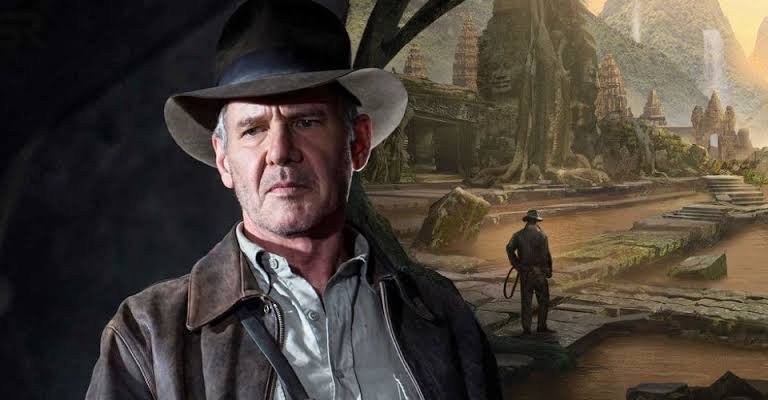
The technology, internally referred to as ILM FaceSwap, involved more than 100 artists and roughly three years of work to create just over 25 minutes of screen time, most of it devoted to the 1944 opening sequence, when Indy is still the agile, relentless adventurer audiences first met in Raiders of the Lost Ark. Ford himself, then 80, described the process with a mixture of fascination and unease. Tracking points were placed across his face while he performed the scenes normally, and the technology combined that present-day performance with decades of archived footage to reconstruct, frame by frame, the face he had worn roughly forty years earlier. The result made Ford one of the oldest actors ever digitally de-aged for a feature film, surpassing the previous benchmark set by Al Pacino in The Irishman.
The decision to open the film this way was anything but accidental. James Mangold, taking over the franchise for the first time after decades with Spielberg behind the camera, wanted to confront the audience with the passage of time rather than hide it. His idea was to begin by giving viewers the young, energetic Indy they had carried in their memories for decades, only to cut sharply to reality: an older man who is slower, more tired, and noticeably grayer, on the verge of retiring from his academic career and, at least in the story, from adventure itself. The contrast was designed to make audiences feel the same passage of time that separated the original 1981 film from this fifth and final chapter.

Because this really was going to be the end. Ford confirmed publicly before the film’s release that Dial of Destiny would mark the definitive conclusion of his journey as Indiana Jones, bringing more than forty years of playing the character to a close at the age of 80. It was an unusually fitting ending for a character whose entire identity had been built around the relationship between the past and the present. Indiana Jones spent his life searching for objects that had survived across centuries, while the final film used modern technology to recover a version of him that had seemingly been lost to time. In the end, the franchise came full circle using the same raw materials that had always defined it: archives, memory, and the desire to recover something that history had taken away. Only this time, the relic being excavated was Indiana Jones himself.