In the late 1950s and throughout the 1960s, DC faced a problem that every successful publisher eventually encounters: the heroes who had defined the Golden Age were beginning to sound dated to a new generation of readers. The answer was not to abandon what already worked, but to reinvent it — and, in the process, expand the universe with names that would bring science, mystery, and a touch of the space age into the pages.
The idea behind this new crop of heroes was to reshape old archetypes with a more modern look, while at the same time daring to create completely new characters capable of capturing the era’s fascination with science and the unknown. It was the Silver Age of comic books, and DC wanted to prove that its universe had room to grow in all directions — including beyond Earth.
It was in this spirit that Barry Allen took up the mantle of the Flash in 1956, reinventing the original concept with a scientific origin that would define the tone of the decade. Hal Jordan became the new Green Lantern in 1959, now linked to an intergalactic corps of guardians. In 1960, the Justice League of America gathered the publisher’s top heroes under a single banner, firmly consolidating the idea of a shared universe. And, to balance out all that solar power, there was the debut in 1955 of the Martian Manhunter, who gained increasing prominence alongside the founders through the 1960s, proving that the universe was deeper than it seemed.
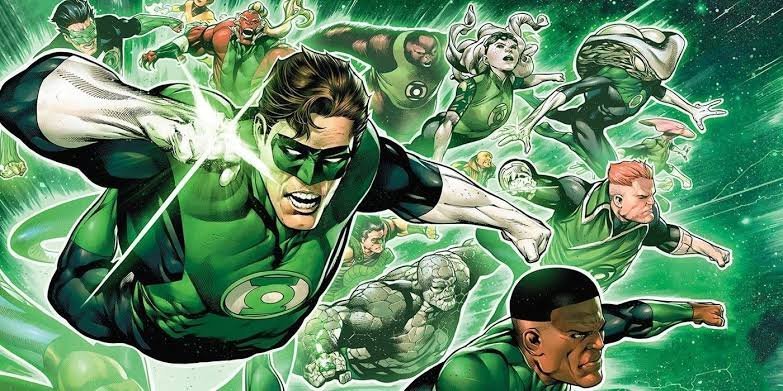
With this new generation added to the original pillars, DC proved that its universe was not static — it was a living organism, capable of reinventing itself each decade without losing the essence that brought it to life.